Cleaning and Caring for a Travel Backpack
Do not put a travel backpack in a washing machine. Clean it by hand with warm water, mild soap and a soft brush, never with detergent or fabric softener, and air dry it away from heat. Keep grit out of the zips, and store a compression bag flat and uncompressed with the valve cap on.
The maintenance schedule
| Interval | Part | What to do | If skipped |
|---|---|---|---|
| After each trip | Interior | Empty completely, turn out and shake | Crumbs and grit migrate into the zips |
| After each trip | Wet pocket | Empty, wipe, leave open to dry | Mildew within days |
| Monthly | Zips | Brush the teeth clean | Grit grinds the teeth until the slider skips |
| Monthly | Base | Wipe with a damp cloth | Abrasive dirt wears the fabric where it sits |
| Quarterly | Straps and seams | Check stitching where straps meet the body | A failing seam becomes a torn one under load |
| Quarterly | Compression bag | Inspect the seal line and valve | A creased seal leaks and the bag re-inflates |
| Yearly | Water repellency | Re-treat with a spray-on DWR if water stops beading | Fabric wets through instead of shedding |
Cleaning, step by step
- Empty every pocket, including the ones you forgot about. Turn the bag upside down and shake it.
- Run a handheld vacuum cleaner over the interior, or wipe it with a damp cloth.
- Mix warm water with a small amount of mild soap. Not detergent. Never fabric softener — it coats the fibre and destroys water repellency faster than years of use.
- Work the outside with a soft brush, in the direction of the weave. Spend the time on the base, which takes most of the wear.
- Rinse with a clean damp cloth until no soap remains. Soap left in the fabric attracts dirt.
- Air dry, open, upside down, away from radiators and direct sun. Heat deforms foam panels and can delaminate coatings.
Zips
A zip is the part that fails first on almost every bag, and grit is almost always why. The teeth act as a grinding surface for whatever gets into them. Brushing them clean once a month is the whole of preventive maintenance.
For a stiff slider, a candle or a graphite pencil rubbed along the teeth works well and attracts nothing. Oil-based lubricants feel like the answer and are the opposite: they collect dust and the zip is worse a month later.
The compression bag and pump
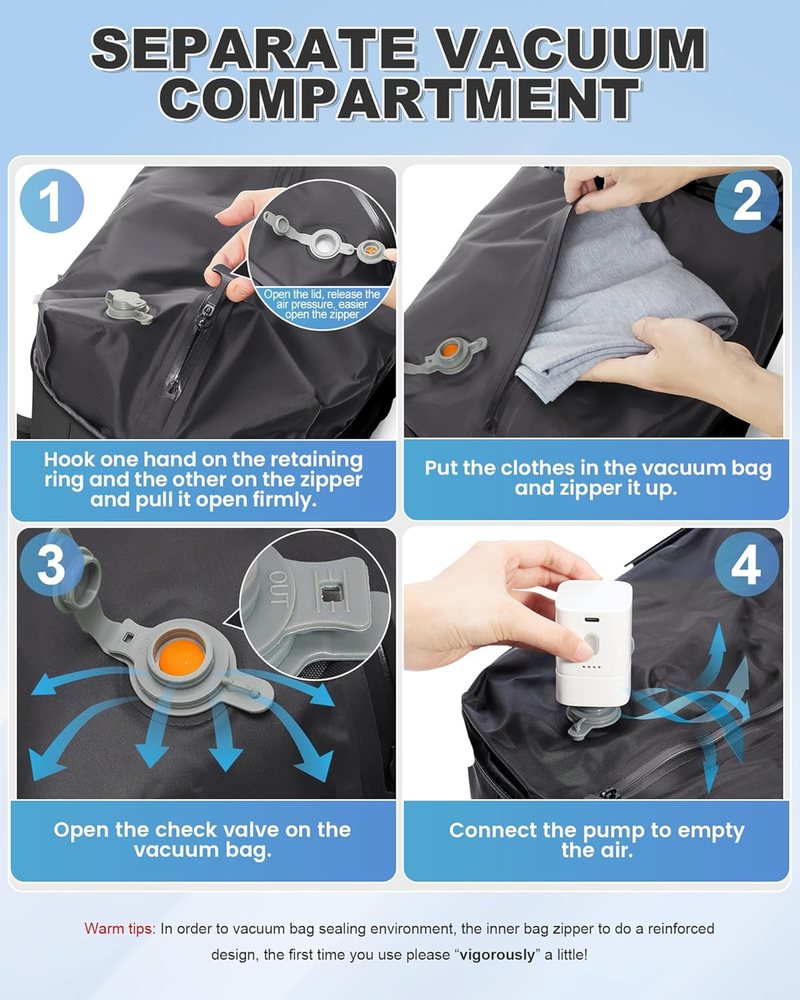
The seal line is the whole mechanism. Store the bag flat and uncompressed, because a crease across the seal is what turns a working bag into one that quietly re-inflates overnight. Keep the valve cap on — a lost cap cannot be replaced and the bag is finished without it.
The pump needs nothing except not being crushed. It is a mechanical part in a bag full of soft ones, so it lives in a pocket rather than loose in the main compartment.
Care FAQ
Can a travel backpack go in the washing machine?
Almost never a good idea. A drum strips the durable water-repellent coating, deforms foam panels and can break plastic hardware. Hand cleaning with warm water and mild soap takes ten minutes and does none of that.
How do I clean water-resistant fabric without ruining it?
Warm water, a soft brush and a mild soap — not detergent, and never fabric softener. Softener coats the fibre and is the fastest way to kill water repellency. Rinse, then air dry away from direct heat.
What do I do about a stiff zip?
Clean the teeth with an old toothbrush first; grit is the usual cause. If it is still stiff, rub a candle or a graphite pencil along the teeth. Oil-based lubricants attract more grit and make it worse within a month.
How should a vacuum compression bag be stored?
Uncompressed, flat, with the valve cap on. Storing it rolled or under pressure creases the seal line, and a creased seal is a seal that leaks. Keep the pump somewhere it will not be crushed.
How long should a travel backpack last?
Years, if the failure points are looked after. What fails first is almost always a zip, then the stitching where a shoulder strap meets the body. Both are checked in seconds and both are repairable long before they become unusable.
Related guides
The personal item size guide →
18 × 14 × 8 inches, what a sizer actually measures, which carriers enforce it, and why the number on the website is not always the number at the gate.
Vacuum compression backpacks explained →
What compression saves, what it cannot save, how the check valve works and the one mistake that breaks the seal on first use.
How to choose a travel backpack →
Opening style, back panel, trolley sleeve and capacity — the four specifications that decide whether a bag suits a trip.