How to Choose a Travel Backpack
Four specifications decide whether a travel backpack suits a trip: how it opens, how much it holds, whether it has a trolley sleeve, and what the back panel is made of. Capacity is the one everyone compares and the least important of the four.
1. How it opens
A top-loading backpack is a hiking design: one long opening at the top, everything stacked vertically, and the thing you need at the bottom. A panel-loading bag unzips around three sides and lies flat, so the contents are visible in one layer and can be repacked without emptying.
For a trip with a single destination the difference is small. For anything with more than two stops it is the specification that decides whether packing feels like a chore. A 180° flat opening — what the 30-litre model has — is the fullest version of this.
2. Capacity, honestly
Capacity is compared because it is a number, not because it is the most useful one. The trap is that a bag gets filled to whatever it holds. A 40-litre bag on a three-day trip comes home 40 litres full and heavy.
The useful question is not "how much can it hold" but "how much do I carry on the trip I actually take most often". The capacity guide works through the arithmetic by trip length.
3. Trolley sleeve
A sleeve on the back panel that slides over a suitcase handle. It costs the manufacturer almost nothing and it is missing from most commuter bags. If a wheeled case ever travels with the backpack, it converts every terminal walk from carrying to pushing.
Check the length. A short sleeve slips off a telescopic handle; the 22 cm sleeve on the 30-litre model is at the useful end of the range.
4. Back panel and straps
Flat foam padding traps heat against the spine. Moulded foam with channels moves air through it. On a cool day the difference is invisible; on a warm concourse with a full bag it is the whole experience of wearing the thing.
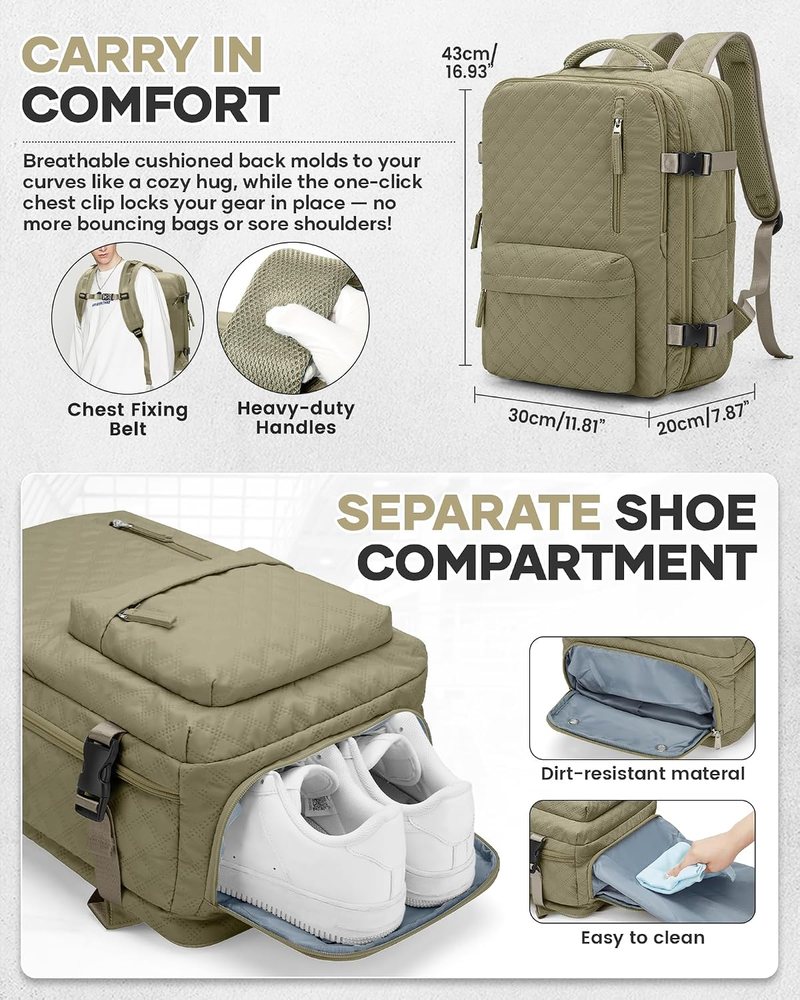
A chest clip matters more than it looks. It stops the shoulder straps splaying outward under load, which is what makes a heavy bag feel like it is pulling backwards.
The specifications that matter less than they seem
| Specification | How much it matters | Why |
|---|---|---|
| Opening style | High | Decides whether repacking means emptying |
| Back panel construction | High | The difference between comfortable and damp |
| Trolley sleeve | High, if you own a case | Converts carrying into pushing |
| Capacity in litres | Medium | Real, but usually over-bought |
| Number of pockets | Low | Past four or five, pockets hide things rather than organise them |
| Waterproof rating | Low | Water-resistant covers rain; nothing short of a dry bag survives submersion |
| Colour | Low, with one exception | Pale fabric shows wear on the base within a year |
Buying FAQ
What matters most when choosing a travel backpack?
How it opens. A panel-loading bag that lies flat packs and unpacks like a suitcase; a top-loading bag means unpacking everything to reach the bottom. On a trip with more than two stops this decides more about the experience than capacity does.
Is a bigger backpack always better?
No, and it is the most common mistake. Capacity gets used because it exists, and a bag packed to 40 litres is heavy whether or not the trip needed it. Buy for the trip you take monthly, not the one you take once a year.
Does a trolley sleeve matter?
It matters more than almost any other feature to anyone who also takes a wheeled case. Without it the backpack is carried through every terminal; with it the backpack rides on the case and the shoulders stay free.
What should the back panel be like?
Moulded foam with channels, not flat padding. The channels move air, and on a warm concourse that is the difference between arriving comfortable and arriving damp.
Related guides
The personal item size guide →
18 × 14 × 8 inches, what a sizer actually measures, which carriers enforce it, and why the number on the website is not always the number at the gate.
Vacuum compression backpacks explained →
What compression saves, what it cannot save, how the check valve works and the one mistake that breaks the seal on first use.
How many litres do you need →
What 24, 30 and 40 litres hold in practice, by trip length and by season, with the packing arithmetic behind it.