Vacuum Compression Backpacks Explained
A vacuum compression backpack has a sealed bag in its own compartment and a hand pump that draws the air out through a check valve. It cuts the volume of bulky clothing by more than half. It does not reduce weight by any measurable amount, and it does almost nothing for dense items such as jeans or books.
What is actually being removed
Bulky clothing is mostly air. A fleece, a puffer jacket, a bath towel — the loft that makes them warm or absorbent is trapped air held in the structure of the fibre. Compression collapses that structure temporarily. What is left is the fabric itself, which is a fraction of the volume and all of the weight.
That single fact explains everything the technology does and does not do. Volume comes down dramatically on lofty items and barely at all on dense ones. Weight does not move.
Where the saving is real
| Item | Air content | Compression benefit |
|---|---|---|
| Down or synthetic jacket | Very high | Large — the clearest case for the system |
| Fleece, knitwear | High | Large |
| Bath towel | High | Large |
| T-shirts, underwear, socks | Moderate | Moderate, mostly from removing folding slack |
| Jeans, chinos | Low | Small |
| Shoes, books, toiletries | None | None — do not put these in the bag |
The sequence, and where it goes wrong
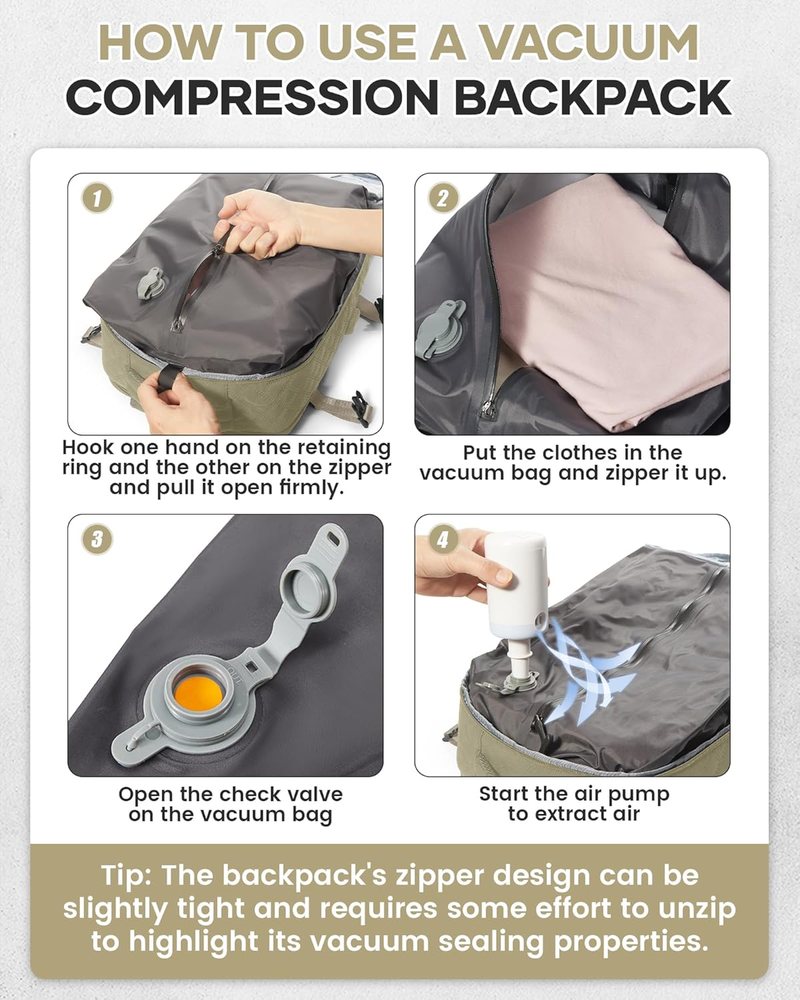
- Open the compartment firmly. One hand on the retaining ring, one on the zip. New bags resist.
- Load only lofty items. Anything rigid punctures the bag or blocks the seal.
- Close the zip fully and firmly. This is the step people get wrong. The zip is deliberately stiff, and the manufacturer's own instruction is to press hard the first time. A seal that is 95 percent closed is not a seal.
- Open the check valve and run the pump. Hold the power button two seconds to start, press once to stop.
- Close the valve cap before removing the pump. Skipping this undoes the previous step immediately.
Nearly every report of a compression bag that "does not hold" traces back to step three or step five. The valve and the zip are the whole mechanism; everything else is a bag.
What it does not solve
- Weight limits. Airlines that weigh cabin baggage are unaffected by compression.
- Height and width. Compression pulls the front panel flat, which helps depth only. See the personal item size guide.
- Fragile items. The bag applies even pressure to everything inside it.
- Access. Getting one shirt out means re-pumping the whole bag.
Living with one
Two habits make the difference. Pack by category rather than by day, so opening one bag does not decompress everything. And compress at home, where there is room and time — a hand pump in an airport queue is a conspicuous way to hold people up.
Several of the models shown here carry the system. The differences between them are size and one extra feature each, not the compression itself.
Compression FAQ
Does vacuum compression reduce weight?
No. It removes air, and air weighs nothing worth measuring. A compressed bag is smaller and exactly as heavy. On airlines that weigh cabin baggage, compression buys nothing at all.
How much space does it actually save?
The manufacturer states more than 50 percent on bulky clothing, which matches what compression does to loft — the trapped air in a fleece, a puffer jacket or a towel. On dense items such as jeans, folded shirts or books the saving is close to nothing, because there is little air to remove.
Why will the vacuum bag not seal the first time?
The zip on a new compression bag is deliberately stiff. The manufacturer's own note says to close it firmly the first time. A partial seal along one section is the usual reason a bag re-inflates within the hour.
Can compressed clothing stay compressed for a whole trip?
A good check valve holds for days. What breaks it is opening the bag to get one item out — after that it has to be pumped again, which is why packing one bag per category rather than one bag for everything is worth the effort.
Does it damage clothes?
It creases them, and it flattens the loft of down for as long as it stays compressed. Down recovers if it is shaken out and hung. Leaving a down jacket compressed for months is what damages it permanently.
Related guides
The personal item size guide →
18 × 14 × 8 inches, what a sizer actually measures, which carriers enforce it, and why the number on the website is not always the number at the gate.
How to choose a travel backpack →
Opening style, back panel, trolley sleeve and capacity — the four specifications that decide whether a bag suits a trip.
How many litres do you need →
What 24, 30 and 40 litres hold in practice, by trip length and by season, with the packing arithmetic behind it.