The Personal Item Size Guide
Most budget carriers that publish a personal-item size quote 18 × 14 × 8 inches, or 45 × 36 × 20 cm. It is a maximum in all three dimensions at once, measured at the gate with a metal sizer against the packed bag. Depth is the dimension most bags fail on, and the only one compression can help with.
Two allowances, two boxes
Cabin baggage splits into two things that are often confused. The personal item goes under the seat in front and is the smaller allowance — on many budget fares it is the only free one. The carry-on goes in the overhead bin, is roughly twice the volume, and on a basic fare usually costs extra.
The practical consequence: if the fare includes only a personal item, the bag has to clear the smaller box or it gets gate-checked and charged. That is the situation the 18 × 14 × 8 dimension exists for.
What the numbers mean
| Allowance | Typical maximum | Where it goes | Usually included |
|---|---|---|---|
| Personal item | 18 × 14 × 8 in / 45 × 36 × 20 cm | Under the seat in front | Yes, on most fares |
| Carry-on | 22 × 14 × 9 in / 56 × 36 × 23 cm | Overhead bin | Often an extra charge on basic fares |
| Checked bag | 62 linear in / 158 linear cm | Hold | Charged separately |
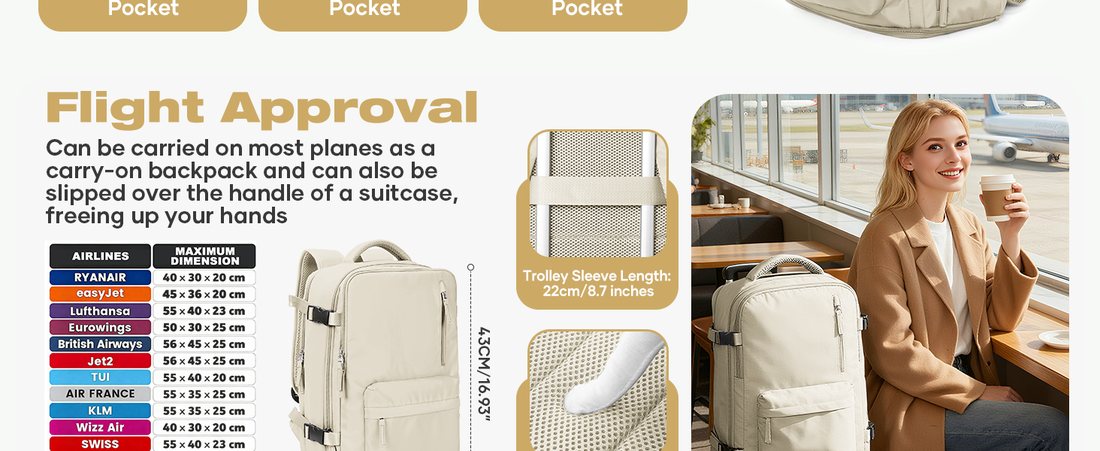
These are the figures that recur across published policies. They are not universal. European low-cost carriers in particular quote their own boxes, and any airline can change the number between the day you book and the day you fly.
How a sizer is actually used
- The bag goes in packed, not empty. A front pocket stuffed with a jacket adds two inches of depth.
- It must go in without force. A gate agent who has to push it is a gate agent who is about to charge you.
- Wheels, handles and straps count. Anything permanently attached is part of the measurement.
- It must come out again. Bags wedged into a sizer are the reason some airlines stopped using them.
Which dimension fails first
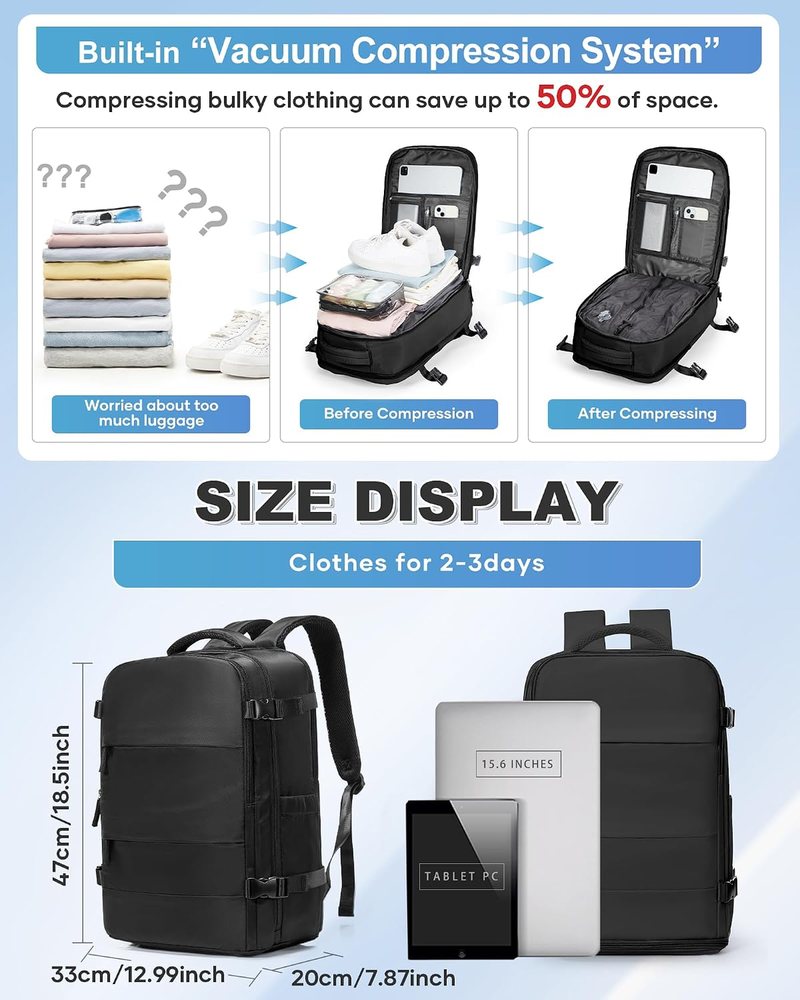
Almost always depth. Height and width are fixed by the frame and by the panels, so a bag that is sold as 18 inches tall stays 18 inches tall. Depth is the soft dimension: it grows with whatever is inside, and it is what turns a compliant bag into a non-compliant one somewhere between home and the gate.
This is the specific problem vacuum compression addresses. Pulling the air out of bulky clothing lets the front panel sit flat against the frame instead of bowing outward. It does nothing for the other two dimensions, which is worth knowing before buying a compression bag expecting it to solve a height problem.
Packing to clear the box
- Heavy and flat against the back panel. Laptop, documents, anything rigid. It also carries better.
- Compress before leaving, not at the airport. A pump is awkward in a queue.
- Keep the front pocket for flat items only. It is the single biggest cause of a depth failure.
- Wear the bulk. A coat worn through the gate is not measured at all.
- Leave the outer straps loose until the sizer. Cinching them after clears a few millimetres.
Personal item FAQ
What size is a personal item on most airlines?
Around 18 × 14 × 8 inches (45 × 36 × 20 cm) on the US budget carriers that publish a number, though several legacy airlines quote a smaller box and a few quote none at all. The figure is a maximum in three dimensions at once — a bag that passes on width and depth still fails if it is too tall.
Do airlines actually measure personal items?
At the gate, with a metal sizer, on the routes where baggage fees matter most. Check-in rarely bothers; boarding often does. The sizer is unforgiving because it measures the packed bag, including whatever is stuffed into the front pocket.
Does a compression backpack help with the sizer?
Only in the dimension the compression acts on. Compressing clothing pulls the front panel flat, which helps with depth — usually the tightest of the three. It does nothing for height or width, which are set by the frame.
Which VGCUB model is built to the personal-item box?
The 18 × 14 × 8 compression model, listed on the models page. The 40-litre model is a cabin bag rather than a personal item.
Related guides
Vacuum compression backpacks explained →
What compression saves, what it cannot save, how the check valve works and the one mistake that breaks the seal on first use.
How to choose a travel backpack →
Opening style, back panel, trolley sleeve and capacity — the four specifications that decide whether a bag suits a trip.
How many litres do you need →
What 24, 30 and 40 litres hold in practice, by trip length and by season, with the packing arithmetic behind it.