Carry-On Versus Personal Item
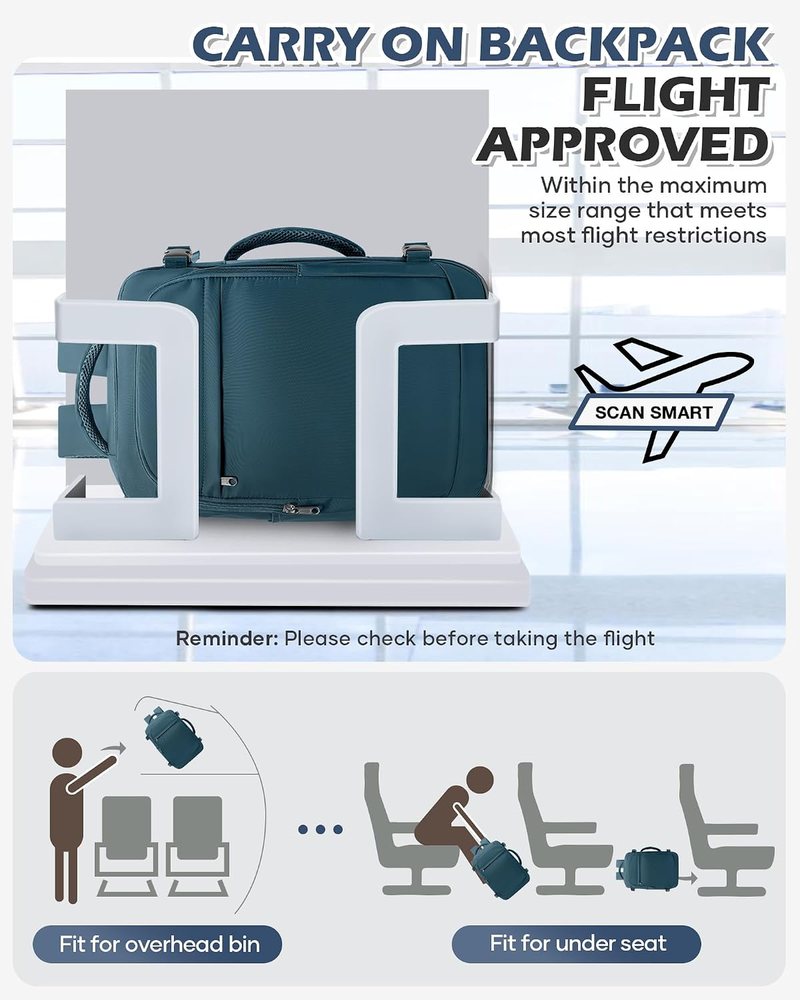
A personal item goes under the seat in front and measures around 18 × 14 × 8 inches. A carry-on goes in the overhead bin at around 22 × 14 × 9. On basic fares the personal item is usually included and the carry-on is charged. A backpack is whichever of the two it physically fits — the bag is measured, not classified.
Two allowances
| Personal item | Carry-on | |
|---|---|---|
| Typical maximum | 18 × 14 × 8 in | 22 × 14 × 9 in |
| Approximate volume | ~25 L | ~45 L |
| Stowed | Under the seat in front | Overhead bin |
| Included on a basic fare | Usually | Often not |
| Reachable in flight | Yes, throughout | Only when the seatbelt sign is off |
| Risk of gate-checking | Very low | Real on a full flight |
The case for travelling on the personal item alone
It is not only about the fare. A bag under the seat is reachable for the whole flight, never gate-checked, never separated from you, and never waiting at the carousel. On a tight connection it is the difference between walking off the aircraft and queueing for the bin.
The cost is discipline. Around 25 litres is not much, and it is the reason compression exists as a category — it is the only way to put a coat into a personal item and still close it.
What counts against the allowance
- The packed bag, not the empty one. Sizers measure what you are carrying.
- Straps, handles and anything permanently attached.
- Whatever is in the front pocket. The most common reason a compliant bag fails.
- Not what you are wearing. A coat worn through the gate is not measured, which is a legitimate and widely used tactic.
Choosing which to travel on
Trips of two or three nights, in a warm climate, with laundry available: the personal item is enough, and the 18 × 14 × 8 model exists for exactly that. Trips longer than that, or into cold weather, or with formal clothing that cannot be creased: take the carry-on allowance and the 40-litre bag.
The measurement detail — how sizers are used, which dimension fails first — is in the personal item size guide.
What the fare actually buys
Baggage is where the headline fare and the final price separate, and the split is deliberate. A basic fare that quotes an attractive number usually includes the personal item only. The carry-on is an add-on, priced in three tiers: cheapest at booking, more at online check-in, and most at the gate — where refusing to pay means the bag travels in the hold anyway.
The practical consequence is that the cost of a bag that does not fit is not a fixed penalty. It is a variable one that peaks at exactly the moment you have no alternative. That is the entire commercial logic behind gate sizers, and it is why the measurement is worth taking seriously before leaving home rather than at the airport.
Packing to the smaller allowance
Travelling on the personal item alone is a discipline rather than a trick, and it comes down to four decisions made before the bag is packed.
- Decide the laundry point. Anything longer than four days without access to a washing machine forces the larger bag. With access, a personal item covers a fortnight.
- Wear the heaviest items. Boots, coat, the bulkiest jumper. Nothing worn through the gate is measured or weighed.
- Compress what has loft, and only that. A coat, a fleece, a towel. Dense items gain nothing — see the compression guide.
- Keep the front pocket flat. It is the dimension that fails, and it fails at the gate rather than at home.
What makes this workable rather than miserable is that a personal item is reachable for the whole flight. The trade is real: less capacity, but the bag is at your feet instead of six rows back and eight bags deep.
Allowance FAQ
What is the difference between a carry-on and a personal item?
Size and where it goes. The personal item fits under the seat in front, at roughly 18 × 14 × 8 inches. The carry-on goes in the overhead bin at roughly 22 × 14 × 9. On a basic fare the personal item is usually free and the carry-on usually is not.
Can I take both?
On most full-service fares, yes. On basic-economy and low-cost fares, often only the personal item is included, and the carry-on is an extra charge that costs more at the gate than it does online.
Is a backpack a personal item or a carry-on?
Whichever box it fits in. A backpack is not a category — a 40-litre backpack is a carry-on and a slim 18-inch one is a personal item. The bag is measured, not classified.
What happens if my bag is too big?
It gets gate-checked, and gate fees are typically the highest price the airline charges for baggage. On a full flight it may also be the last bag onto the aircraft and the last one off.
Related guides
The personal item size guide →
18 × 14 × 8 inches, what a sizer actually measures, which carriers enforce it, and why the number on the website is not always the number at the gate.
Vacuum compression backpacks explained →
What compression saves, what it cannot save, how the check valve works and the one mistake that breaks the seal on first use.
How to choose a travel backpack →
Opening style, back panel, trolley sleeve and capacity — the four specifications that decide whether a bag suits a trip.